 EN

How Tile Levelers Work: Core Mechanisms and System Types
Why Flatness Alone Isn’t Enough—The Role of Tensile Control and Vertical Alignment
A tile leveler does not flatten the substrate or correct floor slope; it aligns adjacent tile edges in a single plane while thin-set mortar cures. This distinction matters because many installers confuse the device with a spirit level, which measures horizontal or vertical orientation. The tile leveler’s core mechanism is tensile control: a clip, base, or strap embedded in the mortar joint transfers pressure to both tile edges, pulling them into vertical alignment. Even on a flat substrate, tile thickness can vary slightly within the same production run, and mortar bed depth may shift during setting. A controlled vertical pull closes these micro-deviations at the joint before the adhesive hardens.
The workflow follows three phases: place the tile, insert the tension component before the mortar skins over, and apply gradual pressure until edges are flush. Over-tightening creates upward force that can snap clips or pop wedges, so tension should be firm but not excessive. Proper tensile control reduces lippage without masking an uneven floor.
Clip-and-Spacer vs. Spin-and-Tighten: Matching System Mechanics to Installation Goals
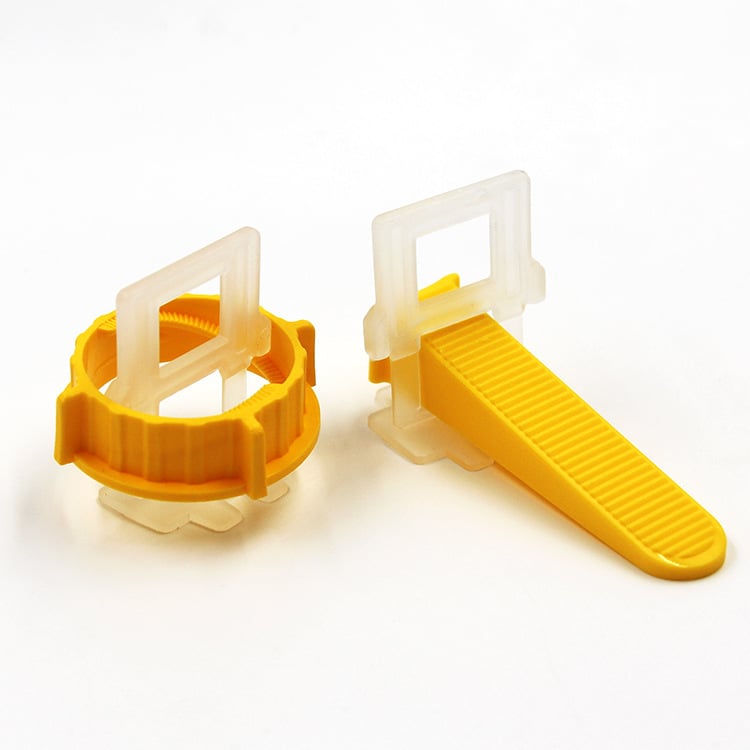
Clip-and-spacer systems are common: a clip sits between tiles, and a wedge slides in, tightened with pliers. The wedge pulls the clip upward, drawing both tile edges down flush. These systems are affordable and have reusable wedges—but over-tightening can pop wedges out. Spin-and-tighten systems use a threaded post and ratcheting cap. Spinning the cap down the post applies progressive, consistent tension without pliers. This mechanism is more precise and stable, though installation is slower and more expensive.
Choose clip-and-spacer for high-volume standard tile work where speed matters. Choose spin-and-tighten for large-format or delicate tiles needing uniform pressure. Matching mechanics to goals prevents under-correction (leaving lippage) and over-correction (damaging edges or clips).
Selecting a Tile Leveler by Tile Characteristics
Porcelain, Ceramic, and Natural Stone: Load Capacity and Edge Sensitivity
Tile material directly affects how much clamping force a tile leveler can apply without damaging the edge. Dense porcelain tolerates higher tension, but brittle natural stone edges chip easily under point loads. For these materials, choose a leveling system with a wide, rigid base plate that spreads pressure evenly and prevents pivoting on thin edges. Standard clips accommodate 3–12 mm thick tiles—covering most ceramic and porcelain installations per industry guidance (2024). Heavier porcelain may require stronger clips or wedges, as single-point tension can cause lippage if the base flexes.
| Material | Key Risk | Leveling Priority |
|---|---|---|
| Porcelain | High density and weight | Strong clip, predictable break point |
| Ceramic | Moderate hardness | Standard wedge, avoid over-tightening |
| Natural stone | Edge chipping, thickness variation | Wide base, moderate even pressure |
Large-Format Tiles (≥24") and Ultra-Thin Tiles (<6mm): When Standard Tile Levelers Fail
Large-format tiles—especially those 24 inches and larger—create longer lever arms on each clip. Standard tile levelers often lack sufficient tensile control across long edges, so installers should add more clips per joint and use systems with reinforced straps or threaded caps. Manufacturer instructions frequently require mechanical leveling for tiles 48 inches and larger (industry guidance, 2024).
Ultra-thin tiles under 6 mm need even more care: the base plate must slip beneath the tile without lifting it, and wedge pressure must stay low enough to avoid cracking the fragile body. For these formats, low-profile, fine-adjustment systems are safer than high-force wedge-only designs.
Factoring in Real-World Installation Conditions
Substrate Type (Concrete, Plywood, Uncoupling Membrane) and Its Impact on Clamp Pressure Distribution
Substrate stiffness changes how a tile leveler delivers clamping force. Concrete provides a rigid base, so installers can apply firm, even pressure without losing vertical alignment. On a concrete slab, a standard clip-and-wedge system works well because the substrate does not compress under normal clamping force.
Plywood flexes under load; overtightening can bow the panel and create voids beneath the tile. Choose a tile leveler with a wider base plate and moderate torque for wood substrates. Uncoupling membranes compress slightly and absorb lateral movement, reducing the effective pull at tile edges. Use deeper clips or taller bases to maintain lip alignment without crushing the membrane.
Test a small area first: press the tile edge with the leveler and check for deflection, gap variation, or membrane collapse. Matching clamp pressure distribution to the substrate prevents chips, hollow spots, and future lippage.
FAQ
What is the primary purpose of a tile leveler?
A tile leveler aligns adjacent tile edges in a single plane while thin-set mortar cures, ensuring a smooth surface by controlling tensile and vertical alignment.
How do clip-and-spacer systems differ from spin-and-tighten systems?
Clip-and-spacer systems use a wedge mechanism to pull tile edges flush, while spin-and-tighten systems use a threaded cap for progressive, precise tension. The former is faster, while the latter offers more precision.
Can I use the same tile leveler for porcelain, ceramic, and natural stone?
Not always. Porcelain tolerates higher clamping force, while natural stone edges are prone to chipping. Choose a leveler designed for the specific material type.
What are the challenges with large-format tiles?
Large-format tiles need additional clips and reinforced leveling systems to ensure proper alignment along their extended edges, as they create longer lever arms on each clip.
How does the substrate affect tile leveling performance?
Different substrates (e.g., concrete, plywood, or uncoupling membranes) affect how clamp pressure is distributed. Match the leveler design to the substrate to avoid issues like deflection, voids, or cracks.
