 EN

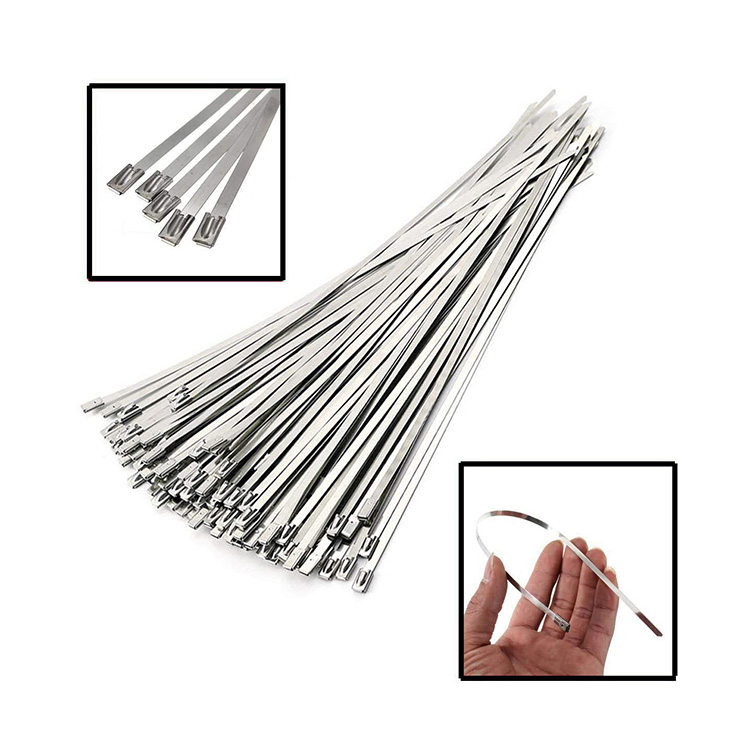
Why Stainless Steel Cable Tie Outperforms Alternatives in Structural Applications
Tensile strength, temperature resilience, and vibration resistance for load-bearing assemblies
In load-bearing assemblies, stainless steel cable ties outperform nylon and coated steel alternatives by combining high tensile strength with stable thermal behavior and exceptional vibration resistance. Standard 304 and 316 grades deliver tensile strengths ranging from 100 lb to 250 lb—scaling predictably with strap width—while maintaining structural integrity across extreme temperatures: from –328°F to 1,000°F. This thermal stability ensures reliability in steam tunnels, rooftop conduit, and fire-rated structural runs where polymer ties soften or deform.
The self-locking ball-barb mechanism prevents slippage under sustained or cyclic loading—a critical advantage over plastic ratchets, which loosen under repeated vibration. Unlike nylon or coated carbon steel, stainless steel exhibits no cold flow or creep, eliminating the need for frequent retorque cycles and reducing long-term maintenance costs. For B2B buyers specifying hangers, clamps, and cable tray supports, this translates directly into improved system longevity and lower total cost of ownership. In mechanical rooms and bridge cable trays—environments subject to high-frequency mechanical vibration—self-locking 316 stainless steel cable ties provide consistent preload retention without degradation.
Real-world validation: Seismic retrofitting of concrete bridges (California DOT, 2022)
A 2022 California Department of Transportation seismic retrofit program validated these performance advantages in practice. Crews replaced corroded steel strapping and nylon ties with ASTM A276 Type 316 stainless steel cable ties on reinforced concrete bridge structures. Post-installation inspections following simulated seismic events confirmed zero loosening or fracture—while adjacent polymer ties exhibited measurable ratchet slip under identical loading conditions.
Because the stainless steel ties maintained full tensile preload through multi-directional cyclic lateral movement, quarterly retightening was eliminated entirely. The success underscores a key principle in load-bearing seismic design: fasteners must preserve clamping force across repeated ground-motion cycles. Traditional straps lose tension after initial deformation; stainless steel cable ties do not. For structural engineering teams, this field-proven outcome reinforces the value of specifying stainless steel cable ties where failure could compromise bridge monitoring systems or impede post-earthquake inspection readiness.
Corrosion Resistance of Stainless Steel Cable Tie in Aggressive Environments
Coastal, industrial, and de-icing salt exposure: Failure modes of conventional fasteners
Conventional fasteners degrade through distinct, often hidden, mechanisms in aggressive environments. Nylon ties exposed to coastal salt spray, industrial acids, or de-icing salts undergo polymer chain scission—leading to embrittlement, surface crazing, and sudden loss of clamping force, often within one or two winter seasons. Coated carbon steel ties (galvanized or epoxy-coated) may resist corrosion initially, but scratches, pinholes, or cut edges expose the base metal to chloride ions. This triggers localized crevice corrosion and rust jacking—the expansion of corrosion products that forcibly loosens the bundle.
Such degradation frequently occurs beneath visible surfaces, resulting in cable sag, conduit separation, or support failure before inspection detects it. Stainless steel cable ties avoid these pitfalls entirely: their alloy matrix resists chloride penetration throughout the cross-section, delivering uniform, bulk-level corrosion resistance—not just surface-level protection.
ASTM A276 316 vs. 304: Passivation layer stability under chloride-laden conditions
Both 304 and 316 stainless steels form a self-healing chromium oxide passivation layer in oxygen-rich environments—but ASTM A276 defines critical compositional differences that determine real-world performance in chloride exposure. Grade 316 contains 2–3% molybdenum; 304 contains none. Molybdenum stabilizes the passive film and dramatically improves resistance to pitting and crevice corrosion—especially at vulnerable sites like cut edges and locking teeth.
The Pitting Resistance Equivalent Number (PREN) quantifies this difference:
| Grade | Chromium | Nickel | Molybdenum | PREN | Typical chloride exposure |
|---|---|---|---|---|---|
| 304 | 18–20% | 8–10.5% | — | 18–20 | Mild industrial, low chloride |
| 316 | 16–18% | 10–14% | 2–3% | 24–26 | Coastal, de-icing salt, high chloride |
For coastal infrastructure, bridge expansion joints, or road surfaces treated with de-icing salts, 316 is the technically appropriate specification. While 304 remains viable for interior, low-chloride industrial applications where budget constraints are paramount, its lower PREN makes it more susceptible to pit initiation during wet-dry cycling—when chlorides concentrate and break down weaker passive films. Specifying ASTM A276 Type 316 stainless steel cable ties mitigates long-term replacement risk and reduces lifecycle maintenance demands in aggressive environments.
Stainless Steel Cable Tie for Electrical and MEP Systems Compliance
Meeting NFPA 70E and IEC 61439 requirements with non-ferrous, non-sparking fastening
Stainless steel cable ties support compliance with NFPA 70E arc flash safety standards and IEC 61439 switchgear integrity requirements—not because they are non-ferrous (they are not), but because their high chromium-nickel content significantly reduces sparking risk during installation and under operational vibration compared with carbon steel fasteners. Inside control panels, busbar compartments, and cable trays, they maintain safe conductor separation and prevent loose bundles from encroaching into restricted zones.
Unlike nylon alternatives, stainless steel does not melt, drip, or embrittle near heat sources—and its corrosion resistance prevents conductive oxide buildup that could create unintended ground paths near live parts. Crucially, 316 stainless steel’s low magnetic permeability avoids interference with sensitive metering, protective relaying, and current transformer circuits. For MEP engineers, these attributes translate into faster visual inspections, stronger fault containment, and reduced arc flash exposure during routine maintenance.
UV-stabilized 316 stainless steel cable tie in high-voltage substation cabling (Texas Grid Upgrade, 2023)
During the 2023 Texas Grid Upgrade, engineers specified UV-stabilized 316 stainless steel cable ties to secure control cables, fiber-optic conduits, and grounding conductors in high-voltage substations. These ties withstood direct sunlight, ozone, wind-driven vibration, and diurnal temperature swings—from freezing nights to 110°F afternoons—without compromising locking force or dimensional stability.
Unlike nylon, 316 stainless does not become brittle under UV exposure or soften near energized buswork. Its smooth-edged, ball-lock design protects cable jackets from abrasion as conductors expand and contract thermally. Field inspections conducted after system energization revealed no cracked, loosened, or degraded fasteners—validating longer maintenance intervals and consistent cable separation required by NESC clearance rules. By eliminating UV-related failures in exposed cable runs, this material choice reduced replacement labor and enhanced long-term system reliability.
FAQ
What is the main advantage of using stainless steel cable ties in structural applications?
Stainless steel cable ties offer high tensile strength, exceptional vibration resistance, and thermal stability, ensuring consistent performance in load-bearing and extreme temperature environments.
Why are 316 stainless steel ties preferred in corrosive environments?
316 stainless steel contains molybdenum, which enhances its resistance to pitting and crevice corrosion, especially in chloride-laden conditions like coastal or de-icing salt exposure.
Can stainless steel cable ties resist UV exposure?
Yes, particularly 316 UV-stabilized stainless steel cable ties are ideal for applications requiring resistance to UV-related brittleness and degradation.
Are stainless steel cable ties suitable for seismic retrofitting?
Absolutely, as shown in the California DOT's seismic retrofit program, stainless steel cable ties maintain their tensile preload and clamping force even under repeated ground-motion cycles.
How do stainless steel cable ties support NFPA 70E and IEC 61439 compliance?
They reduce sparking risk and provide excellent corrosion resistance, making them compliant with electrical safety and switchgear integrity standards.
Table of Contents
- Why Stainless Steel Cable Tie Outperforms Alternatives in Structural Applications
- Corrosion Resistance of Stainless Steel Cable Tie in Aggressive Environments
- Stainless Steel Cable Tie for Electrical and MEP Systems Compliance
-
FAQ
- What is the main advantage of using stainless steel cable ties in structural applications?
- Why are 316 stainless steel ties preferred in corrosive environments?
- Can stainless steel cable ties resist UV exposure?
- Are stainless steel cable ties suitable for seismic retrofitting?
- How do stainless steel cable ties support NFPA 70E and IEC 61439 compliance?
