 EN

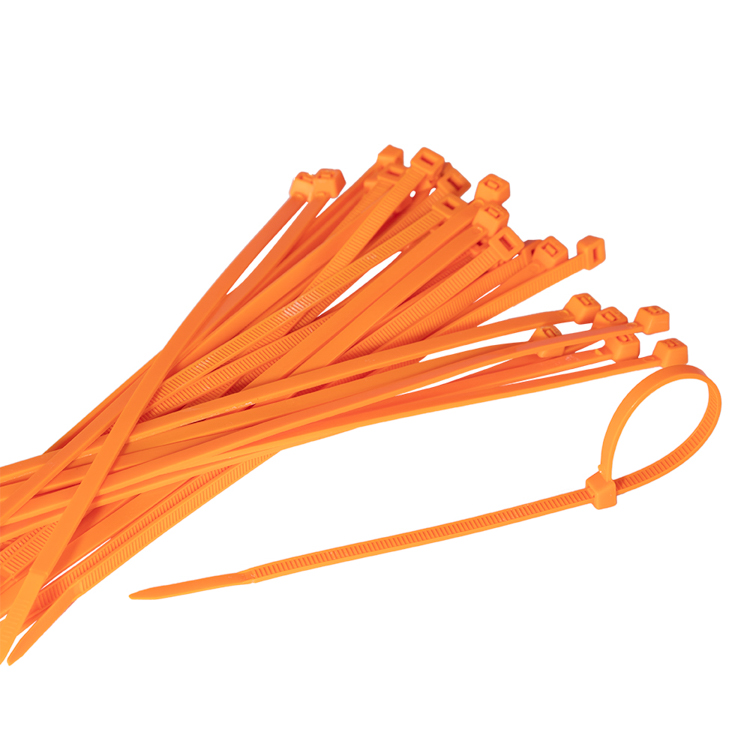
Why Nylon 6/6 Is the Optimal Material for Durable Nylon Cable Tie
Molecular structure and crystallinity: How nylon 6/6 delivers superior tensile strength and thermal stability
Nylon 6/6 (polyhexamethylene adipamide) derives its mechanical edge from a highly regular molecular backbone. Repeating amide (–CO–NH–) groups spaced precisely by six-carbon segments allow adjacent chains to form extensive, dense hydrogen-bond networks. This structural order facilitates rapid crystallization when the melt is cooled under controlled conditions, with crystalline domains acting as load-bearing anchors. In virgin grades, this molecular architecture translates to a tensile yield strength of 70–85 MPa, as confirmed by ASTM D638 testing. The high-strength intermolecular forces also push the melting point to roughly 265°C, permitting continuous service at temperatures up to 85°C without significant loss of stiffness. For more demanding environments, heat-stabilized formulations maintain integrity at 121°C. Another practical benefit is low creep: the crystalline regions resist chain slippage, so a properly installed nylon cable tie retains clamping force over years—even under sustained static load. Together, high crystallinity and hydrogen-bond density provide the ideal blend of rigidity, strength, and thermal stability for industrial fastening.
Additives and purity: UV inhibitors, heat stabilizers, and high-grade polymerization for extended service life
Raw polymer properties are only half the story; additive packages and resin purity dictate long-term field performance. Standard nylon 6/6 absorbs UV radiation and degrades quickly outdoors—often losing tensile strength within 1–2 years. Incorporating UV inhibitors—most commonly finely dispersed carbon black—extends outdoor durability to 7–9 years, as validated by QUV accelerated weathering per ASTM G154. Heat stabilizers, such as copper-halide systems, slow thermo-oxidative breakdown, enabling the material to withstand continuous temperatures up to 121°C without embrittlement. Equally important is the quality of the base resin: high-grade polymerization processes minimize residual monomers and create a uniform molecular-weight distribution. This purity reduces microvoids that can act as crack initiation sites, improving impact resistance and long-term reliability. Some formulations also include internal lubricants to ease fastening without compromising locking force. By selecting a nylon cable tie that pairs tailored additives with a high-purity resin, engineers ensure consistent mechanical performance across diverse industrial settings—from chemical plants to solar farms.
Mechanical Performance: Strength, Flexibility, and Brittleness Resistance in Nylon Cable Tie Applications
Tensile strength benchmarks and real-world retention: ASTM D638 data and load performance across sizes (e.g., 50+ lb for 4.8 mm × 250 mm)
The load-bearing capacity of a nylon 6/6 cable tie is validated through tensile testing per ASTM D638. A typical 4.8 mm-wide × 250 mm-long tie routinely sustains vertical loads exceeding 50 lb (≈222 N) before yield—confirmed by both laboratory pull-tests and field-service data. Smaller profiles, such as a 2.5 mm-wide tie, may exhibit break strengths around 18 lb, while heavy-duty variants (9 mm width) can withstand up to 250 lb—a span demonstrating the material’s exceptional strength-to-volume ratio. Critically, these values reflect retained clamping force after repeated vibration and thermal cycling, a key requirement in industrial harnesses where loosening is unacceptable. By benchmarking against ASTM D638, operators can confidently select the correct size for specific bundles, ensuring circumferential pressure remains stable throughout service life without catastrophic failure.
Precision engineering: Tooth geometry, surface finish, and balanced flexibility-to-rigidity ratio
Mechanical reliability extends beyond raw material strength to the refinement of the locking head and strap. The internal tooth profile is precisely angled—typically a 30° to 45° ramp—with a sharp-tolerance surface finish that minimizes insertion effort while maximizing bite. This engineered geometry creates a high-friction one-way engagement, preventing backward slip even under oscillating loads. A smooth, burr-free surface further reduces galling of the strap, preserving nylon’s inherent flexibility so the tie conforms to irregular shapes without cracking. The balance between flexibility and rigidity is achieved through controlled crystallinity and wall thickness: a tie that is too stiff becomes brittle and snaps during tightening; one that is overly pliable fails to maintain tension. Properly designed nylon cable ties leverage this equilibrium—allowing the strap to be cinched tightly, flex repeatedly without fracture, and lock into a rigid, creep-resistant loop that withstands long-term static and dynamic stresses.
Environmental Durability: UV, Temperature, and Chemical Resistance of Nylon Cable Tie
Outdoor longevity: QUV and ISO 4892-3 weathering test results and field validation in industrial settings
Accelerated weathering tests under QUV (ASTM G154) and ISO 4892-3 protocols confirm the long-term resilience of UV-stabilized nylon 6/6 cable ties in outdoor settings. After 1,000 hours of UV-A exposure—equivalent to several years of sunlight—carbon-black-filled variants retain over 95% of initial tensile strength and show no surface cracks. Field data from audited renewable energy installations reinforce these lab findings: tie wraps on photovoltaic arrays routinely exceed a decade of service without embrittlement. Telecom tower operators report that black nylon ties outperform unstabilized alternatives through seasonal heat, moisture, and sustained UV exposure—consistently preventing bundle-related failures. This alignment of controlled testing and real-world performance demonstrates that proper polymer stabilization delivers reliable, maintenance-free endurance in harsh industrial environments—reducing replacement cycles and lifecycle costs.
Design Integrity: Locking Mechanism and Structural Reliability in Long-Term Nylon Cable Tie Use
The self-locking mechanism defines the reliability of a nylon cable tie in long-term installations. A ratchet-and-pawl design—where the strap’s serrated teeth engage a flexible pawl inside the head—creates a one-way lock that tightens with tension and resists loosening under vibration or load. This irreversible grip eliminates gradual slackening, a common failure mode in temporary or reusable fasteners.
High-integrity tooth geometry is critical: precisely molded teeth with consistent pitch and depth distribute stress evenly, preventing strap slippage at rated loads. The pawl must balance stiffness and flexibility—too rigid and it fractures during insertion; too compliant and it releases prematurely. Leading designs use a tapered pawl profile that flexes during assembly and locks flat once seated, increasing holding force as tension rises.
For extreme environments, nylon 6/6 bodies with integrated stainless-steel teeth add a redundant locking stage, boosting tensile retention and vibration resistance. Self-locking nylon ties achieve loop tensile strengths from 18 to over 175 lbs, with the highest-grade models sustaining loads >50 lbs for a 4.8 mm × 250 mm tie. Field data from industrial facilities show that properly specified locking nylon cable ties maintain clamping force after 10,000+ thermal cycles—outperforming releasable alternatives that degrade up to 40% faster under identical conditions.
A well-engineered, permanently locked nylon cable tie translates to fewer maintenance interventions and secure cable management across decades of service.
FAQ
What makes nylon 6/6 an ideal material for cable ties?
Nylon 6/6 offers high tensile strength, thermal stability, low creep, and excellent durability. Its molecular structure, high crystallinity, and hydrogen bond density make it perfect for heavy-duty applications.
How long do UV-stabilized nylon cable ties last outdoors?
UV-stabilized cable ties can last 7–9 years outdoors, withstanding significant sunlight exposure as validated by QUV accelerated weathering tests.
What are some advantages of using additives in nylon cable ties?
Additives like UV inhibitors, heat stabilizers, and internal lubricants enhance durability, reduce cracking, and improve performance in extreme conditions.
What tensile strengths can nylon cable ties support?
Depending on size, tensile strengths range from 18 lbs for smaller ties to over 250 lbs for heavy-duty variants.
How do nylon cable ties maintain long-term clamping force?
Features like precision-tooth geometry, balanced flexibility, and a self-locking ratchet-and-pawl mechanism ensure secure tension and minimal creep over extended periods.
Table of Contents
- Why Nylon 6/6 Is the Optimal Material for Durable Nylon Cable Tie
- Mechanical Performance: Strength, Flexibility, and Brittleness Resistance in Nylon Cable Tie Applications
- Environmental Durability: UV, Temperature, and Chemical Resistance of Nylon Cable Tie
- Design Integrity: Locking Mechanism and Structural Reliability in Long-Term Nylon Cable Tie Use
- FAQ
