EN
EN

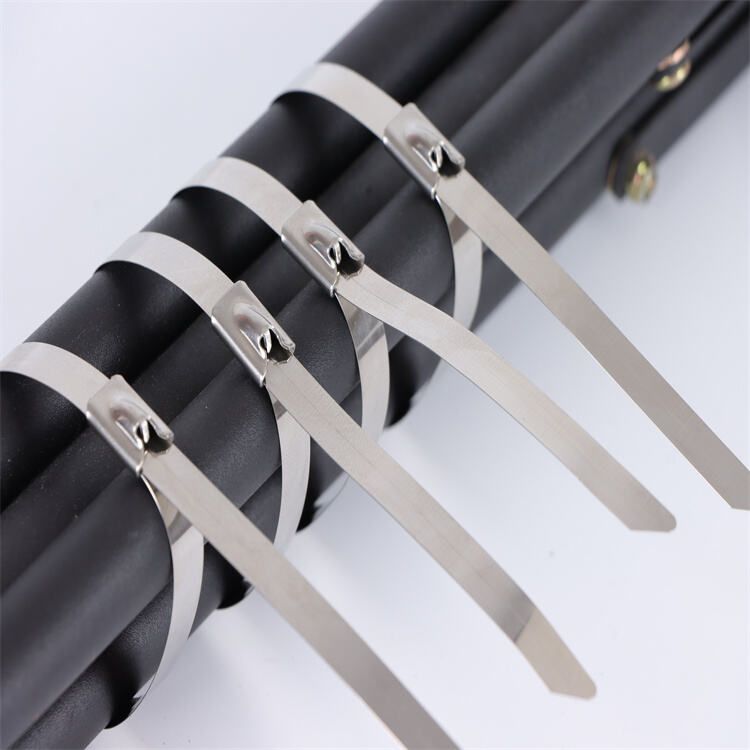
Tensile Strength and Real-World Load-Bearing Capacity of Stainless Steel Cable Ties
Tensile strength is the fundamental property that determines how much load a stainless steel cable tie can support before failing. However, selecting the right tie for heavy-duty fixing requires understanding not just the rated numbers, but how they translate to long-term performance under real-world conditions.
Yield vs. ultimate tensile strength: What the numbers mean for heavy-load applications
Yield strength is the stress at which a stainless steel cable tie begins to deform permanently, while ultimate tensile strength is the maximum stress reached before fracture. For sustained heavy loads, yield strength is the critical metric—exceeding it causes irreversible relaxation of clamping force, leading to bundle loosening even if the tie does not break. Typically, yield strength ranges between 60–70% of the ultimate value. For example, a 7.9 mm wide tie with a rated ultimate tensile strength of 163 kgf has a yield threshold of approximately 98–114 kgf. To account for installation variability and long-term creep, engineers apply a safety factor of 1.5 to 2.5 on yield strength. Per IEC 62275, continuous service loads should not exceed 50% of the rated ultimate tensile strength—keeping the tie within its elastic region and ensuring reliable grip over time. This distinction is essential in applications like pipe hangers or cable tray bundling, where progressive loss of tension poses infrastructure risks.
304 vs. 316 stainless steel cable ties: Comparative load ratings (N/mm², kgf, and safety margins)
From a pure tensile perspective, 304 and 316 stainless steel grades exhibit nearly identical mechanical properties: both deliver yield strengths around 205 MPa and ultimate tensile strengths up to 515 MPa. As a result, load ratings for a given size are functionally equivalent across grades. The table below summarizes typical values for common widths:
| Width (mm) | Tensile Strength (kgf) | Safe Working Load at 1.5× margin (kgf) |
|---|---|---|
| 4.6 | 89 | 35–45 |
| 7.9 | 160–163 | 64–75 |
| 12.0 | 320 | 128–150 |
Because material strength is comparable, the same safety margin applies to both grades. However, 316 stainless steel provides superior resistance to saltwater, chlorides, and aggressive chemicals—environmental factors that can trigger pitting or stress corrosion cracking in 304. In marine or chemical processing settings, this degradation may reduce a 304 tie’s effective strength by 30–50% within a few years, while 316 retains structural integrity and load capacity over decades. Thus, while initial load ratings are identical, only 316 guarantees long-term load security in corrosive environments.
Why rated tensile strength alone is insufficient—accounting for dynamic stress, installation torque, and creep
Static tensile values assume ideal conditions: slow, steady loading in a controlled environment. Real-world use introduces variables that significantly reduce usable capacity. Vibration—common in mining conveyors or offshore platforms—can initiate fatigue cracks at loads as low as 20–30% of ultimate tensile strength. Overtightening during installation introduces micro-cracks at the locking mechanism, potentially reducing effective strength by up to 20%. Creep—the time-dependent elongation under constant load—also erodes clamping force: at 60°C and 50% ultimate load, a tie may relax 10–15% over one year. To ensure reliability, engineers routinely derate the rated tensile strength by 30–50%, incorporating allowances for vibration fatigue, thermal cycling, installation variability, and long-term creep. This conservative approach ensures the tie remains within its safe elastic range throughout its intended service life.
Design Factors That Maximize Heavy-Load Performance in Stainless Steel Cable Ties
Width, Thickness, and Cross-Sectional Geometry: Engineering Stress Distribution for Sustained Loads
Physical dimensions directly govern how tensile stress is distributed across the tie’s cross-section. Wider and thicker ties spread load more evenly, lowering peak stress and delaying localized yielding. For heavy-duty applications, ties with a minimum width of 9 mm and thickness of 0.5 mm are standard—delivering static load capacity exceeding 2000 N without permanent deformation. Geometry also affects bending stiffness: a rectangular profile with rounded edges minimizes stress concentrations and improves conformability to irregular surfaces. Proper dimensional selection ensures the tie’s full rated tensile strength is practically achievable—not compromised by shape-induced stress risers.
Ratchet Locking Mechanism Reliability: Fatigue Resistance Under Vibration, Thermal Cycling, and Repeated Loading
The locking head is the most highly stressed component—and often the failure point—in any cable tie. Premium stainless steel designs use spring-loaded ball-bearing or precision-machined ratchet pawls that engage hardened serrations along the strap. These mechanisms maintain secure engagement under constant tension, high-frequency vibration, and repeated thermal cycling. Unlike polymer locks, metal-on-metal contact resists creep and maintains clamping force across temperature extremes. Quality ball-bearing locks withstand repeated loads from 540 N to 2200 N—well beyond the fatigue limits of plastic alternatives—while enabling precise, controlled tensioning during installation. This combination of robust engagement and thermal stability ensures consistent load retention over the asset’s full operational lifetime.
Heavy-Duty Industrial Applications Where Stainless Steel Cable Ties Deliver Critical Load Security
Marine, oil & gas, and mining environments: Securing high-vibration infrastructure with corrosion-resistant load integrity
Marine, oil & gas, and mining operations subject fasteners to extreme vibration, abrasive particulates, and corrosive agents—conditions that rapidly degrade plastic alternatives. Stainless steel cable ties maintain structural integrity and rated tensile strength under these stresses. Offshore platforms rely on grade 316 ties to secure heavy cable bundles against wave forces and wind loads; refineries leverage their chemical resistance to withstand corrosive vapors; and mining equipment benefits from fatigue-resistant ratchets that endure continuous mechanical shock. Their ability to operate reliably from -78°C to 537°C further extends suitability to turbine enclosures, kilns, and cryogenic systems. In all cases, stainless steel delivers load security unattainable with non-metallic fasteners.
Environmental Resilience as a Load-Preservation Factor for Stainless Steel Cable Ties
Stainless steel cable ties preserve tensile strength in environments where plastic ties degrade rapidly. Exposure to saltwater, industrial chemicals, or extreme temperatures (-78°C to 537°C) compromises nylon’s structural integrity within 2–3 years. In contrast, 316-grade stainless steel resists pitting, crevice corrosion, and chloride-induced stress corrosion cracking—maintaining 98% of initial load capacity after 15+ years in marine or industrial settings, per long-term material longevity studies.
Environmental resilience directly sustains load security:
- Corrosion resistance prevents metal thinning and cross-sectional weakening
- Thermal stability preserves tensile strength across the full operational temperature range
- UV immunity eliminates molecular degradation that undermines plastic ties
| Material | Corrosion Resistance | Temperature Range | Avg. Lifespan | Load Retention After 10y |
|---|---|---|---|---|
| Nylon 6/6 | Low-Moderate | -40°C to 85°C | 2–5 years | ≤40% |
| 316 Stainless Steel | Excellent | -78°C to 537°C | 15+ years | ≥95% |
Leading manufacturers confirm that environmental resilience prevents progressive strength loss—ensuring stainless steel cable ties meet original load specifications throughout service life. This consistency is non-negotiable in safety-critical infrastructure.
FAQ
1. What is the difference between yield strength and ultimate tensile strength?
Yield strength is the stress level at which a stainless steel cable tie begins to deform permanently, whereas ultimate tensile strength is the maximum stress the tie can withstand before breaking.
2. Why is 316 stainless steel better for corrosive environments?
316 stainless steel offers superior resistance to saltwater, chlorides, and aggressive chemicals, maintaining load capacity over decades in corrosive conditions compared to 304 stainless steel ties.
3. How is rated tensile strength affected in real-world applications?
Real-world factors like vibration, installation errors, and creep can reduce a tie's usable capacity, prompting engineers to apply safety margins of 30–50% to ensure reliability.
4. Can stainless steel cable ties handle high temperatures?
Yes, 316 stainless steel cable ties operate reliably in temperatures ranging from -78°C to 537°C, ensuring strength and performance across thermal extremes.
5. How do stainless steel cable ties compare to nylon ties in longevity?
Stainless steel ties, especially grade 316, retain over 95% load capacity for 15+ years, while nylon ties degrade within 2–5 years and retain only ≤40% load capacity after 10 years.
Table of Contents
- Tensile Strength and Real-World Load-Bearing Capacity of Stainless Steel Cable Ties
- Design Factors That Maximize Heavy-Load Performance in Stainless Steel Cable Ties
- Heavy-Duty Industrial Applications Where Stainless Steel Cable Ties Deliver Critical Load Security
- Environmental Resilience as a Load-Preservation Factor for Stainless Steel Cable Ties
- FAQ