EN
EN


Tile Leveler Core Mechanism: Replacing Manual Shimming with One-Step Alignment
Eliminating Iterative Adjustments: From Multiple Re-Checks to Single-Clamp Precision
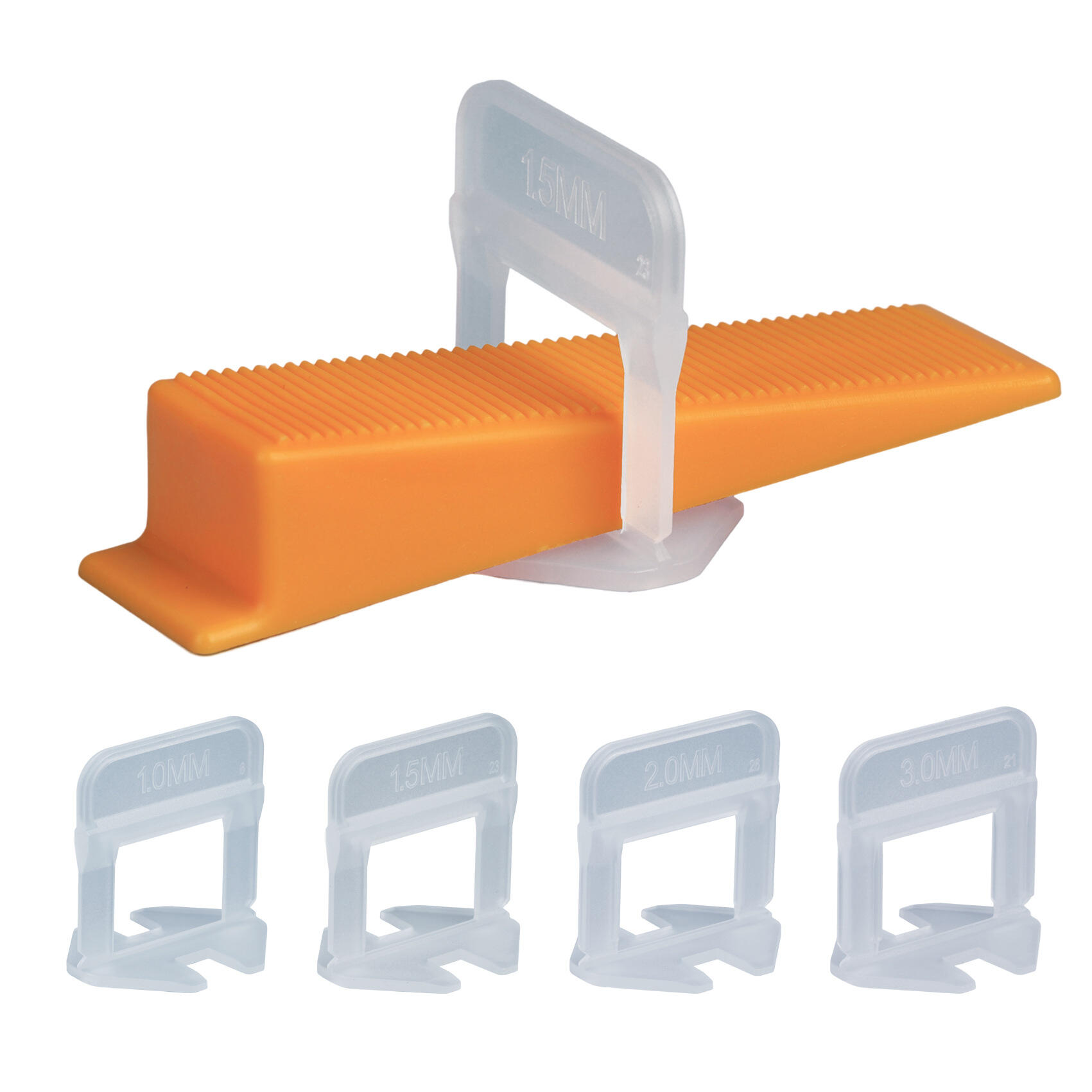
Traditional tiling demanded repeated manual interventions: installers placed spacers, checked tile height with a straightedge, adjusted shims, and re-checked—often multiple times per joint. A tile leveler replaces this labor-intensive cycle with a single, decisive action. The system uses a plastic clip positioned beneath adjacent tile edges, with a tail extending vertically through the grout joint; a reusable wedge then clamps onto that tail. When tightened with pliers, the wedge applies uniform downward pressure—forcing tile edges into perfect alignment in one motion. This integrated spacing-and-leveling function locks tiles in place immediately, eliminating the need for revisit adjustments. Field trials confirm this one-step alignment reduces time spent on height corrections by over 50%, allowing crews to focus on laying rather than correcting.
Integrated Clamp-and-Lock Design Enables Simultaneous Tile Positioning Across Large Areas
The clip-and-wedge architecture supports true parallel workflow—unlike manual shimming, which requires sequential, individual tile stabilization. After laying a row of clips, installers can insert and tighten wedges across multiple joints at once, either individually or using multiple tools. Crucially, all clamped tiles remain under consistent tension during adhesive cure, preventing lippage caused by mortar shrinkage or settling. On a 100-square-meter floor, dozens of tiles achieve precise planar alignment concurrently. Reusable wedges are collected after clipping off tails and redeployed—further streamlining operations. By unifying spacing, leveling, and holding into a single mechanical action, the system transforms large-area tiling from a slow, iterative process into a fast, repeatable, high-fidelity installation.
Measurable Time Savings: Accelerating Subfloor-to-Tile Readiness
Real-World Data: 37% Faster Turnaround in Commercial Fit-Outs (UK, 2023)
Tile levelers deliver quantifiable efficiency gains in commercial environments. A 2023 UK industry study of 12 commercial fit-out projects found an average 37% reduction in overall tiling schedule duration when using modern leveling systems versus traditional methods. This acceleration stems directly from eliminating manual alignment steps—no repeated measuring, no shim repositioning, no post-placement verification. Crews achieve plane uniformity across large zones in real time, reducing measurement error and adjustment cycles while maintaining full compliance with BS 5385-1:2018 standards for tile installation tolerances.
Productivity Shift: Cutting Prep Time from 4–6 Hours to Under 2.5 Hours per 100 sqm
Subfloor-to-tile readiness has shifted dramatically with leveling technology. Where traditional methods required 4–6 hours per 100 square meters for positioning and fine-leveling, advanced systems now complete the same scope in under 2.5 hours—a 58% improvement. This leap is driven by simultaneous multi-tile alignment: installers secure height relationships across entire sections in one motion, while the clamping mechanism maintains consistent joint spacing without operator intervention. The result is not just speed—it’s sustained output with reduced physical fatigue and fewer posture-related strain incidents among tilers.
Lippage Reduction as a Workflow Accelerator: Minimizing Rework and QA Delays
How Near-Zero Lippage Eliminates Tile Re-Setting, Inspection Holds, and Sign-Off Bottlenecks
Tile levelers consistently achieve lippage under 0.5 mm across contiguous surfaces—well within the ≤1 mm tolerance specified in ANSI A108.02 and BS 5385-1:2018. This near-zero deviation eliminates the most common trigger for rework: misaligned tiles requiring removal and resetting after adhesive cure. Because the clamp-and-lock mechanism holds tiles immovably during mortar hydration, height drift is virtually eliminated—removing the root cause of post-cure lippage. Consequently, quality assurance teams rarely issue non-conformance reports for alignment, avoiding inspection holds and re-inspection cycles. In multi-trade settings, this accelerates handover to downstream trades—electricians, painters, and flooring finishers gain earlier access to clean, certified surfaces. QA sign-off becomes scalable: instead of inspecting tile-by-tile, inspectors validate entire zones at once, trusting the system’s repeatability. The time saved on avoided rework typically offsets the initial tool investment within a single medium-sized project.
Tile Leveler ROI in Multi-Trade Environments: Balancing Investment Against Crew Throughput Gains
For construction sites governed by tight, interdependent trade schedules, tile levelers deliver ROI far beyond material cost savings. A typical starter kit—including caps, wedges, and pliers—represents a modest capital outlay, yet it directly eliminates the repetitive re-checks and readjustments that stall tiling crews. Independent productivity audits show a ~40% reduction in labor hours per square meter—translating to over two reclaimed work hours per tradesperson on a 100 m² floor. In practice, this means the tiling team finishes earlier, releasing critical workspace for electricians, painters, and other finish trades without cascading delays. The return isn’t confined to tiling labor alone; it manifests as accelerated project milestones, reduced site overhead, and improved contractor reputation for reliability. As noted by the UK’s National Federation of Builders, tools that compress critical path tasks—like tile leveling—deliver the highest marginal ROI in fast-track commercial delivery.
FAQ
What is the core function of a tile leveler?
The core function of a tile leveler is to replace manual shimming and alignment processes with a one-step system that levels and spaces tiles simultaneously.
How much time can tile levelers save on a project?
Real-world data indicates that tile levelers can reduce tiling time by up to 37%, with subfloor-to-tile readiness being completed 58% faster compared to traditional methods.
What are the benefits of the clamp-and-lock design?
The clamp-and-lock design enables simultaneous multi-tile alignment and consistent tension during curing, preventing lippage and improving overall installation efficiency.
What is the average reduction in labor hours using tile levelers?
Tile levelers can deliver approximately a 40% reduction in labor hours per square meter by eliminating repetitive verification and adjustment steps.
How do tile levelers affect ROI in multi-trade environments?
Tile levelers provide ROI through accelerated project timelines, reduced labor costs, and minimized rework, benefiting multiple trades reliant on accurate tiling.
Table of Contents
- Tile Leveler Core Mechanism: Replacing Manual Shimming with One-Step Alignment
- Measurable Time Savings: Accelerating Subfloor-to-Tile Readiness
- Lippage Reduction as a Workflow Accelerator: Minimizing Rework and QA Delays
- Tile Leveler ROI in Multi-Trade Environments: Balancing Investment Against Crew Throughput Gains
- FAQ