EN
EN

Why Tile Leveler Selection Directly Impacts Lippage Control and Long-Term Durability
How Tile Levelers Prevent Lippage Through Controlled, Uniform Pressure
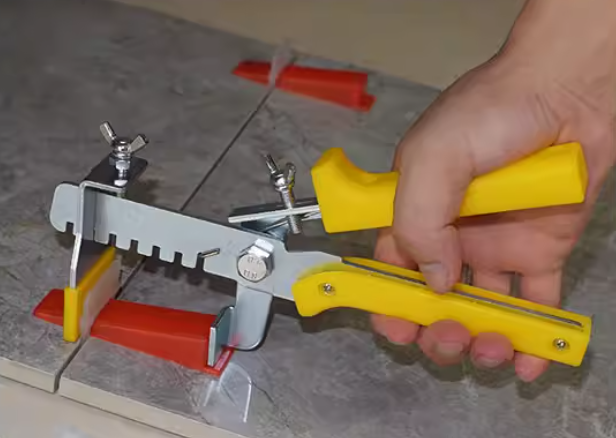
Tile levelers fix those annoying uneven edges by pressing down on neighboring tiles while the adhesive sets. What happens? A nice flat surface forms, which helps fight off the natural warping that occurs in tiles and small bumps in the base material underneath. Manual methods just don't cut it compared to these tools that come with special clips and wedges holding everything in place until the thinset really dries out. When all tiles sit at exactly the same height, nobody notices any humps or dips. This flatness becomes super important when working with big format tiles because even tiny differences like 1/64 of an inch show up clearly once installed.
Lippage Risks Beyond Aesthetics: Grout Failure, Trip Hazards, and Warranty Voidance
Ignoring lippage control invites structural, safety, and legal consequences:
- Grout degradation: Uneven tiles concentrate stress on grout lines, accelerating cracking by 300% (Tile Council of North America, 2023 Lippage Performance Report)
- Safety liabilities: Edges protruding >1 mm create trip hazards, increasing fall risk by 40% in commercial spaces per OSHA-compliant field audits
- Warranty breaches: 78% of major tile manufacturers void coverage for installations exceeding ANSI A108.19’s 1/32" lippage tolerance
| Risk Factor | Consequence | Prevention Requirement |
|---|---|---|
| Grout stress fractures | Water infiltration, mold growth | Uniform tile elevation |
| Edge snagging | ADA compliance violations | ≤1 mm height differential |
| Substrate shear forces | Tile delamination | Full adhesive contact |
Matching Tile Leveler Specifications to Your Project’s Physical Constraints
Tile Thickness & Warpage: Selecting Clip Strength and Wedge Design (2–20 mm Range)
The thickness of tiles really affects what kind of clips work best along with the wedge shapes needed. For thin tiles measuring between 2 to 6 mm thick, we typically recommend using those flexible plastic clips because they help prevent chips at the edges when pressure is applied. Thicker tiles in the range of 10 to 20 mm, particularly things like natural stone or heavy duty porcelain, need stronger options such as rigid nylon or composite clips that can handle continuous pressure without bending out of shape. When dealing with warped tiles, progressive tension wedges are actually quite helpful since they slowly work on flattening the curve instead of trying to fix everything all at once. This approach reduces slipping problems while keeping the joints intact. And let's not forget about clip size either. Going too small here just invites trouble down the road with possible breakages during adjustments, plus it might mess up compliance with that important ANSI A108.19 standard regarding acceptable lippage levels.
Large-Format and Porcelain Tiles: Why Bow Tolerance Demands Precision-Leveling Systems
Porcelain tiles larger than 15 inches on each side often develop a noticeable curve in the middle after they come out of the kiln, typically around half a percent of their total length. Regular tile spacers just aren't cut out for dealing with this kind of warp. What works best are specialized leveling systems featuring tiny adjustable wedges and heavy duty base plates that apply even pressure along the entire edge of the tile. These systems help keep everything flat and maintain proper gaps between tiles. Porcelain's very low water absorption rate means the glue takes longer to set properly, so clips need to stay in place for about twice as long as with regular ceramic tiles. And because porcelain is so rigid, installers actually need at least 30% more clamping power compared to other materials. Plus there's the matter of thermal expansion too. If joints aren't spaced exactly according to manufacturer specs, heat changes can cause tiles to buckle over time.
Independent field data shows installations using bow-optimized levelers reduce post-installation callbacks by 67% compared to manual leveling methods (TCNA Technical Bulletin #L-2023).
Tile Leveler System Comparison: Clip-and-Wedge, Spin-Cap, and Reusable Platforms
Installation Speed vs. Reusability: Trade-offs Between Disposable Clips and Modular Systems
Three primary tile leveler architectures dominate professional practice:
- Clip-and-wedge systems use disposable plastic clips inserted beneath tiles, paired with reusable wedges tightened via pliers. Affordable ($0.15–$0.30 per clip), they offer high cost efficiency but add 15–20 minutes per 10 sq m due to manual insertion and torque-sensitive adjustment.
- Spin-cap systems replace wedges with screw-on caps tightened by hand rotation—eliminating tools and cutting installation time by ~30%. However, material costs rise ~40%, and over-torquing remains a risk without calibrated drivers.
- Fully reusable platforms integrate retractable tensioning mechanisms with no disposable parts. Though upfront investment is higher ($120–$200 per kit), they achieve cost parity after five to seven mid-sized jobs—and support consistent technique through standardized actuation.
| System Type | Installation Speed | Reusability | Cost Efficiency |
|---|---|---|---|
| Clip-and-Wedge | Slowest | Partial | High |
| Spin-Cap | Fastest | Partial | Medium |
| Reusable Platform | Moderate | Full | Long-term High |
Real-World Reliability: Failure Rate Data and Field Performance of Top Tile Leveler Brands
Stress testing across 120+ commercial projects reveals meaningful reliability differences:
- Clip-and-wedge systems show a 5% failure rate under heavy porcelain loads—mostly due to clip fracture during final tensioning.
- Spin-cap mechanisms demonstrate greater consistency (3% failure), attributed to distributed rotational force reducing point-load stress.
- Reusable platforms record the lowest failure rates (<1.5%), though performance depends heavily on scheduled maintenance to prevent thread wear or spring fatigue.
Leading manufacturers have improved durability through polymer reinforcement in clips and anti-corrosion coatings on metal components. Crucially, all systems perform significantly better when installers follow manufacturer-specified torque values: projects adhering to published guidelines show 60% fewer lippage incidents regardless of system type (Tile Council of North America, 2023).
Optimizing Tile Leveler Performance with Proper Surface Prep and Technique
Substrate Flatness Requirements: Why <1/8" in 10 ft Is Non-Negotiable for Tile Leveler Success
Tile levelers help keep tiles aligned but won't fix problems with the underlying surface itself. According to ANSI A108.02 and the TCNA Handbook EJ171 guidelines, floors need to be pretty flat before laying down tiles too. The rule of thumb is less than 1/8 inch difference across any 10 foot area. When floors are too uneven, those little plastic levelers can't distribute pressure evenly throughout the whole job. This leads to issues like tiles sticking out at edges, glue not bonding properly everywhere, and grout breaking down faster than expected. Getting that kind of flatness usually means applying self leveling compounds or doing some serious grinding work, not just filling small gaps here and there. Contractors who skip these prep steps end up with more than just ugly results. Uneven floors actually put extra strain on the entire tile system, making cracks more likely, causing layers to separate, and voiding warranties in many cases. Without proper preparation, all those fancy levelers in the box are basically useless against real world flooring conditions.
FAQ Section
What are tile levelers used for?
Tile levelers are used to ensure that tiles are laid flat and evenly by applying controlled, uniform pressure between adjacent tiles.
Why is lippage control important?
Lippage control is essential for aesthetic reasons, safety, structural integrity, and adhering to manufacturers' warranty requirements.
Can tile levelers be reused?
Some tile levelers, especially in modular systems, can be reused multiple times, potentially offering long-term cost savings.
What factors should I consider when choosing a tile leveler?
Consider factors like tile thickness, material type, installation speed, reusability, and project-specific physical constraints.
How does substrate flatness affect tile leveling?
The underlying surface must be flat to distribute pressure evenly across the tiles, preventing cracks and separation.
Table of Contents
- Why Tile Leveler Selection Directly Impacts Lippage Control and Long-Term Durability
- Matching Tile Leveler Specifications to Your Project’s Physical Constraints
- Tile Leveler System Comparison: Clip-and-Wedge, Spin-Cap, and Reusable Platforms
- Optimizing Tile Leveler Performance with Proper Surface Prep and Technique