 EN
EN

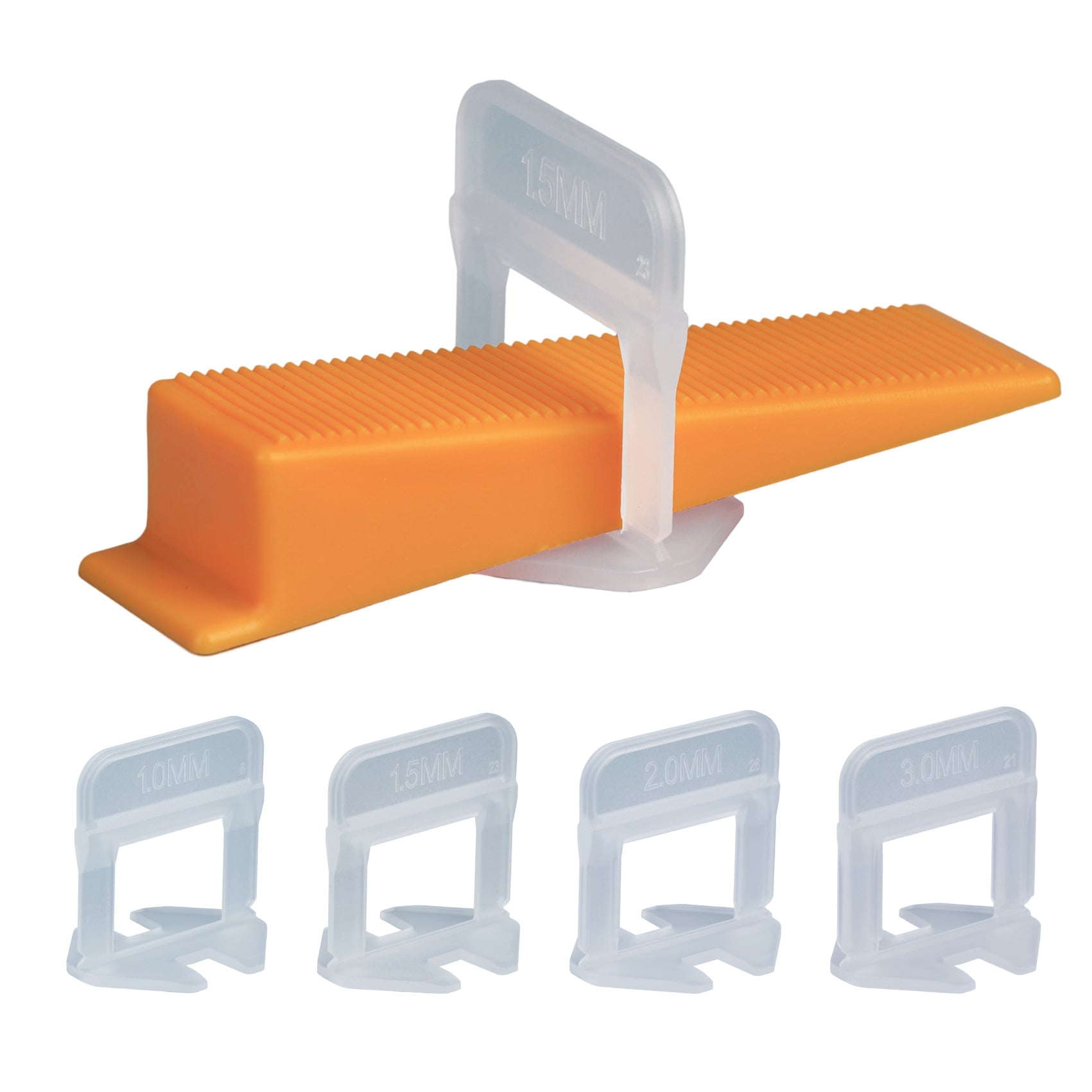
Core Performance Features of a Reliable Tile Leveler
Sturdy Base and Precision Lippage Control
A reliable tile leveler begins with a sturdy, precision-engineered base — the foundation that anchors the entire system. It serves dual roles: maintaining uniform grout joint widths and delivering consistent, sub-millimeter lippage control. Unlike flimsy alternatives that allow deviations up to ½ inch, high-performance bases achieve flatness tolerances of 1/16 inch over 10 feet, verified by running a loose wedge across adjacent tiles — any snag indicates height inconsistency a quality system eliminates.
Crucially, the base must distribute clamping force evenly across tile edges and corners, especially for large-format panels. Flexing during tightening is a common failure point that reintroduces lippage immediately. Robust three- or four-way junction designs secure corners firmly, transforming individual tiles into a single, continuous plane — not just aligned, but integrated.
Smooth Tightening Mechanism and Clean Break-Off Design
The tightening mechanism directly impacts speed, consistency, and installer endurance. A smooth, ergonomic pliers-operated system delivers even pressure with minimal hand fatigue — critical for high-polish surfaces where uneven force risks micro-cracking. Professional-grade tools provide tactile feedback, signaling optimal pressure without over-torquing.
Equally important is the break-off design. After thin-set cures, the base must detach cleanly. Top-tier systems feature a stress notch at the bottom of the grout joint, enabling a single mallet strike or kick to snap the tab flush with the mortar bed. Poor designs leave jagged protrusions requiring manual scraping — risking chipped tile edges and delaying grouting. A predictable, clean fracture ensures joints are ready for grout immediately, preserving both tile integrity and project timelines.
Tile-Specific Compatibility and Project Fit
Matching Tile Leveler to Size, Thickness, and Material (Including Warped Wood-Look Porcelain)
A truly versatile tile leveler adapts seamlessly across formats — from 3 mm mosaics to 20 mm stone slabs — using adjustable spacers that require no tool changes. For warped wood-look porcelain planks, which often exhibit subtle bowing, robust clamping force across the full edge compensates for curvature, pressing the tile fully into adhesive and eliminating lippage.
The base width must be sufficient to prevent stress concentrations on large-format porcelain — a key factor in avoiding edge cracks. Systems compliant with ANSI A108.16 for large-format tile installation meet rigorous standards for uniform pressure distribution. Interchangeable clips and universal compatibility (with both proprietary and conventional levelers) simplify inventory, while anti-slip feet enhance stability on uneven underlayments. Crucially, secure gripping must occur without marring delicate surfaces like polished porcelain — and consistent joint spacing must be maintained even when tiles vary slightly in thickness.
Scaling the System: Small Repairs vs. Large-Format Commercial Installations
The best tile leveler systems scale effortlessly — from a bathroom floor repair to a 10,000 sq ft commercial lobby — using identical components across all tile sizes. Modular, universal designs eliminate retraining and reduce inventory complexity. For large-scale work, speed and durability converge: single-handed locking mechanisms boost output, while reusable parts cut material waste and long-term cost. Quick-change spacer kits minimize downtime when switching between thicknesses.
In commercial applications, repeated use demands resilience: components must resist fatigue, deformation, or loss of tension over hundreds of installations. Selecting a system validated by the National Tile Contractors Association (NTCA) ensures performance consistency — whether leveling ten tiles or ten thousand — delivering flat, durable surfaces every time.
Tile Leveler System Types: Function, Efficiency, and Trade-Offs
Spinning, Wedge, Strap, and Hybrid Systems Compared
System choice shapes installation rhythm, precision, and scalability. Each type balances speed, control, and cost differently:
| System Type | Main Advantage | Key Trade-off |
|---|---|---|
| Wedge (Clip-and-Wedge) | Fast installation, low upfront cost | Clips are typically single-use; tension relies on installer feel |
| Spinning (Spin-Cap) | Calibrated, repeatable tension; no specialized tools needed | Slower setup per tile; higher initial investment |
| Hybrid | Combines wedge-speed with reusable, ratcheting precision | Higher complexity and cost than standard options |
Selection hinges on job priorities — not installer preference alone. As noted in RUBI’s tile leveling system comparison, experienced professionals may favor wedge systems for rapid coverage on standard formats, while spinning or hybrid systems excel with large-format or sensitive tiles where uniform pressure prevents breakage and guarantees flatness.
Usability, Durability, and Long-Term Cost Efficiency
Ergonomic Pliers, Reusability Rate, and Grout Joint Preservation
Ergonomics are non-negotiable in high-volume work. Pliers with soft-grip handles and smooth ratcheting or twisting action reduce fatigue and repetitive strain — enabling faster, more consistent installations without compromising quality.
Reusability drives long-term value. Premium spinning-cap systems withstand dozens of uses; even mid-tier reusable clips achieve 10+ cycles, slashing per-tile consumable costs. While upfront investment may be higher, lower material spend and fewer callbacks deliver strong ROI — especially on commercial projects.
But durability must never compromise grout joint integrity. A well-designed break-off mechanism snaps straps or tabs below the tile surface — never chipping edges or widening joints. Preserved joints accept grout evenly, cure uniformly, and resist cracking under thermal or structural movement. When comfort, reuse, and joint protection align, the tile leveler becomes more than a tool — it’s a long-term asset for professional results.
FAQ
Why is lippage control important in tile leveling?
Lippage control ensures adjacent tiles are aligned consistently, preventing tripping hazards and creating a smooth, flat surface. It’s especially important for large-format tiles where height inconsistencies can be more pronounced.
What makes the break-off design important in a tile leveling system?
A clean break-off design prevents jagged protrusions and ensures grout joints are ready for grouting immediately, minimizing delays and protecting tile edges from damage.
Are spinning-cap systems better than wedge systems?
Spinning-cap systems provide calibrated tension and reusability, making them ideal for large-format and sensitive tiles. Wedge systems are often faster but rely on installer experience for optimal tension.
