 EN
EN

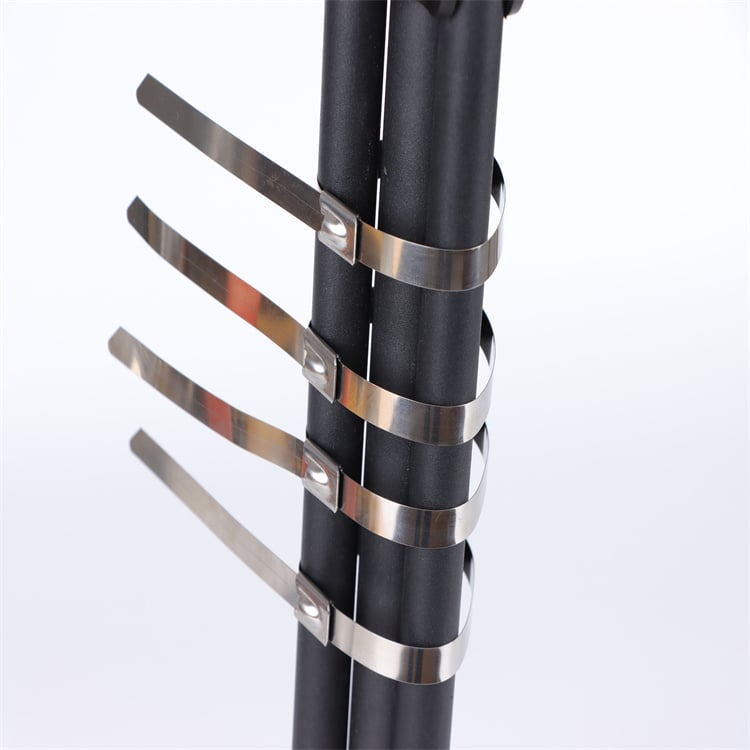
Unmatched Corrosion Resistance for Decades-Long Reliability
ASTM B117 salt spray validation: 1,000+ hours with no red rust in marine and chemical environments
A stainless steel cable tie’s long-term reliability starts with its inherent corrosion resistance—validated by the ASTM B117 salt spray test. This accelerated test exposes samples to a continuous 5% NaCl mist at 35°C, simulating aggressive marine and chemical atmospheres. After 1,000+ hours, high-quality 304 and 316 stainless steel cable ties show no red rust or pitting; nylon ties become brittle and UV-degraded, while galvanized steel ties typically corrode within 200–300 hours. The absence of red rust confirms that the chromium-rich passive oxide layer remains intact, blocking chloride-induced attack on the underlying metal. In real-world applications—from offshore platforms and chemical processing plants to coastal infrastructure—this translates to decades of sustained clamping force and structural integrity, eliminating the risk of catastrophic failure that could compromise cables, conduits, or safety-critical systems.
Passive oxide layer stability: How 304 and 316 stainless steel cable tie grades perform over 30 years
The passive layer responsible for stainless steel’s corrosion resistance is a self-healing film of chromium oxide. Its long-term stability depends on alloy composition—and the choice between 304 and 316 directly determines service life in harsh environments.
| Grade | Key alloying elements | Corrosion mechanism | Typical 30‑year performance in coastal/chemical settings |
|---|---|---|---|
| 304 | 18–20% Cr, 8–10.5% Ni | Thin Cr₂O₃ layer; susceptible to chloride pitting (PREN ≈ 18) | Moderate pitting may appear after 15–20 years; not recommended for direct salt spray |
| 316 | 16–18% Cr, 10–14% Ni, 2–3% Mo | Molybdenum-enriched oxide layer resists crevice and pitting corrosion (PREN ≥ 24) | Remains virtually rust-free and structurally sound after 30 years of marine exposure |
A 2023 independent corrosion study confirmed that 316 stainless steel cable ties retained >98% of their original tensile strength after a 30-year simulated marine aging cycle, while 304 ties showed localized pitting depths of 0.2–0.5 mm. The molybdenum in 316 stabilizes the passive film against chloride penetration—ensuring consistent performance from day one through decade three. For installations exposed to salt, acids, or industrial chemicals, 316 delivers the long-term reliability 304 cannot match.
Consistent Tensile Strength and Vibration Fatigue Resistance Over Time
ISO 17225-2 data: >95% tensile strength retention after 10 years at elevated temperatures (85°C)
Stainless steel cable ties maintain exceptional mechanical integrity under long-term thermal stress—a key advantage over polymer alternatives. Testing aligned with ISO 17225-2 shows that after a decade at 85°C, both 304 and 316 grades retain over 95% of their original tensile strength. This reflects the metallurgical stability of austenitic stainless steels, which resist creep and stress relaxation even under sustained load. In contrast, nylon ties in comparable hot zones—such as engine compartments or thermal processing lines—can lose half their strength within two years. Engineers specifying fasteners for high-temperature applications rely on this proven retention to extend maintenance intervals and avoid unplanned downtime.
IEC 60068-2-64 testing: Zero failure under 10 million vibration cycles — critical for rail and offshore applications
Vibration fatigue is a leading cause of premature cable management failure—but stainless steel cable ties demonstrate exceptional resilience. Per IEC 60068-2-64 broadband random vibration testing, they withstand 10 million excitation cycles without cracking, loosening, or measurable degradation. Their high stiffness and intrinsic damping suppress micro-fretting and fatigue crack initiation—critical for environments like offshore rigs and high-speed rail, where constant oscillatory loads accelerate wear. On trains operating across 20–200 Hz frequency bands, or rigs subjected to wave-induced motion, zero-failure performance ensures bundled cables stay secure, preventing chafing, insulation damage, and electrical faults. This benchmark directly supports safety-critical reliability where even one loose bundle risks cascading system failures.
Stable Performance Across Extreme Environmental Conditions
UV immunity vs. nylon degradation: UL 746C-compliant stainless steel cable tie retains full integrity outdoors for 5+ years
Stainless steel cable ties are inherently immune to UV radiation—no additives or coatings required. Standard nylon ties, by comparison, photodegrade rapidly: ASTM G155 testing shows they lose over 60% of tensile strength after just 3,000 hours of accelerated UV exposure. Independent weatherometer testing (xenon-arc, 5,000 hours) confirms that 304-grade stainless steel ties exhibit zero surface degradation and full strength retention—equivalent to more than five years of direct sunlight in harsh climates. This UV stability extends seamlessly into coastal and chemically aggressive settings, where salt spray and acidic rain accelerate polymer breakdown. Because the protective oxide layer self-renews, installers eliminate recurring inspection, replacement, and labour costs—delivering lasting reliability for solar farms, telecom towers, and marine infrastructure.
Wide thermal tolerance: No embrittlement or creep from -200°C to +800°C
Austenitic stainless steel cable ties maintain consistent mechanical properties across an extraordinary thermal range—from cryogenic to extreme heat—unlike nylon, which embrittles below -40°C and softens above 150°C. Cryogenic tensile tests confirm no ductility loss at -200°C; elevated temperature exposures show negligible creep at 800°C—well beyond the scaling threshold for most alloys. This stability stems from the face-centered cubic crystal structure, which resists dislocation movement during thermal cycling. In oil & gas downhole tooling, refinery cable management, or aerospace engine harnessing, stainless steel eliminates thermal aging failures—ensuring clamping force remains constant without retensioning or replacement. A single stainless steel tie thus outperforms multiple nylon alternatives across the full operational spectrum.
Total Cost of Ownership Advantage: Low Maintenance and Extended Lifespan
When evaluating fastening solutions for long-term infrastructure, the true financial impact extends far beyond initial purchase price. While stainless steel cable ties carry a higher upfront cost than nylon, their value emerges clearly when accounting for replacement cycles, labour, and system downtime. Nylon ties degrade rapidly under UV, chemical exposure, and thermal cycling—typically requiring replacement every 2–4 years outdoors. In contrast, a 316 stainless steel cable tie sustains mechanical and corrosion performance for 30+ years with zero maintenance—shifting from a consumable to a permanent assembly component.
A lifecycle cost comparison illustrates the savings:
| Cost Factor | Nylon Cable Tie (per 100‑unit bundle) | Stainless Steel Cable Tie (per 100‑unit bundle) |
|---|---|---|
| Unit price (initial) | $12 | $95 |
| Expected lifespan outdoors | 3 years | 30+ years |
| Replacement events over 15 years | 5 | 0 |
| Labour cost per replacement (in‑situ) | $45 | — |
| Total material cost over 15 years | $60 | $95 |
| Total labour cost over 15 years | $225 | $0 |
| Total 15‑year cost | $285 | $95 |
Assumptions: outdoor industrial setting; labour rated at $45 per replacement visit; stainless steel tie installed once.
Even excluding the cost of unscheduled outages or safety-critical failures, stainless steel delivers a 67% lower total outlay over 15 years. In rail, marine, or chemical processing environments—where a single fastener failure can halt operations—the avoidance of unplanned maintenance strengthens the business case significantly. Specifying stainless steel at the design stage pays for itself many times over, delivering permanent bundling—not recurring maintenance.
Frequently Asked Questions (FAQ)
What is the ASTM B117 salt spray test?
The ASTM B117 salt spray test is an accelerated corrosion testing method that exposes samples to a controlled 5% NaCl mist at 35°C to simulate harsh marine and chemical atmospheres.
How does stainless steel resist corrosion?
Stainless steel resists corrosion through its chromium-rich passive oxide layer, which prevents chloride-induced attacks on the metal's surface.
What’s the difference between 304 and 316 stainless steel cable ties?
316 stainless steel contains molybdenum, which offers significantly better resistance to pitting and crevice corrosion compared to 304 in marine and chemical environments.
Can stainless steel cable ties handle UV exposure?
Yes, stainless steel cable ties are immune to UV radiation and outperform nylon ties that degrade under prolonged sun exposure.
What is the lifecycle cost advantage of stainless steel cable ties?
While initially more expensive, stainless steel cable ties last over 30 years with no maintenance, offering a 67% lower total cost compared to nylon ties over a 15-year period.
