EN
EN

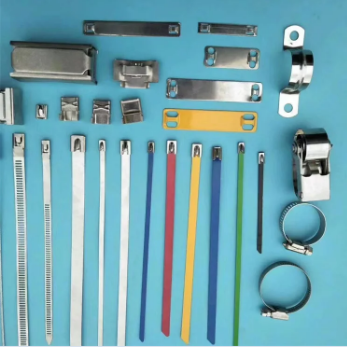
Unmatched Tensile Strength for Heavy-Duty Applications
How AISI 304 and 316L Stainless Steel Deliver 150–300+ lbs Breaking Strength
Stainless steel cable ties achieve breaking strengths of 150–300+ pounds—far exceeding plastic alternatives—thanks to the inherent tensile properties of AISI 304 and 316L stainless steel. Cold-working during manufacturing aligns the alloy’s metallic grains, enhancing resistance to deformation under load. Unlike polymers that creep under sustained stress, these steels retain dimensional stability even at up to 90% of their yield strength. The 316L grade delivers a notable advantage: its 2–3% molybdenum content strengthens the crystalline lattice, boosting ultimate tensile strength by ~15% over standard grades while preserving ductility—enabling reliable absorption of shock loads in demanding industrial settings.
Real-World Validation: Securing 280-lb Vibrating Bundles in Paper Mill Conveyors
A Midwest paper mill secured 280-pound paper rolls on high-vibration conveyors operating at 1,200 RPM using stainless steel cable ties. After 14 months of continuous service—including exposure to humidity, airborne fiber debris, and cyclical accelerations exceeding 28G—the ties showed zero failures. In contrast, previously used reinforced nylon ties required monthly replacement due to fatigue-induced fractures. The switch eliminated $3,200/month in maintenance costs and prevented roll-separation incidents that had caused 12 hours of annual production downtime. This outcome underscores how stainless steel cable ties deliver operational reliability where plastic alternatives consistently fail under multi-axis mechanical stress.
Superior Corrosion Resistance in Harsh Industrial Environments
Long-Term Performance: Zero Degradation After 5 Years in Marine and Petrochemical Settings
Stainless steel cable ties maintain structural integrity for five years or more in aggressive environments—including continuous saltwater immersion and petrochemical vapor exposure—without visible corrosion. This durability arises from a self-repairing chromium-rich passive oxide layer that reforms instantly when scratched or abraded. Their resilience spans extreme pH conditions, from acidic refinery emissions (pH < 2) to alkaline marine atmospheres (pH > 12). Field data from industrial operators show a 60% reduction in replacement frequency compared with zinc-coated or polymer-coated metal ties, translating directly into lower lifecycle maintenance costs.
Why 316L Stainless Steel Outperforms Plastic Under Saltwater, Acidic Vapors, and UV Exposure
The 316L grade’s molybdenum content (2–3%) provides exceptional resistance to chloride-induced pitting—a critical advantage in offshore, coastal, and chemical processing applications. When securing cabling on offshore rigs, 316L stainless steel cable ties resist degradation where plastic alternatives typically fail within months. Independent laboratory testing confirms its superiority across key stressors:
| Exposure | Plastic Tie Failure | 316L Stainless Steel Performance |
|---|---|---|
| Saltwater spray | 6–12 months | No corrosion after 5+ years |
| 10% sulfuric acid | Immediate embrittlement | Full structural integrity |
| UV radiation | Cracking in 18 months | Zero degradation observed |
This metallurgical robustness ensures long-term clamping force retention—preventing dangerous loosening in safety-critical infrastructure like chemical plants, wastewater facilities, and maritime systems.
Stainless Steel Cable Tie vs Plastic: Critical Failure Points in Heavy-Duty Use
Data-Driven Insight: 92% Nylon Tie Failure in Offshore Wind Turbine Cabling Within 18 Months
Offshore wind turbine installations reveal a stark performance gap: 92% of nylon cable ties used for cabling failed within 18 months, according to field studies conducted across North Sea and Atlantic deployments. This near-total failure rate results from synergistic stressors—UV radiation embrittling polymer chains, salt crystals promoting micro-fracture growth, and constant 15–20 Hz vibrations accelerating fatigue. Failed ties led to cable slippage, abrasion damage, and electrical faults—contributing to turbine downtime costing over $740,000 per day (Ponemon Institute, 2023). These findings confirm that plastic ties lack the material resilience needed for multi-stress, mission-critical energy infrastructure.
Selection Framework: When to Specify Stainless Steel Cable Tie Based on Temperature, Chemical, and Mechanical Stress Thresholds
Stainless steel cable ties become the engineering default when environmental demands exceed plastic’s functional limits. Use this evidence-based framework to guide specification decisions:
| Stress Factor | Plastic Limit | Stainless Steel Threshold | Failure Consequence |
|---|---|---|---|
| Temperature | Degrades above 185°F (85°C) | Maintains integrity to 1400°F (760°C) | Melting/embrittlement |
| Chemical Exposure | Fails with acids/alkalis | Resists pH 1–14 solutions | Material dissolution |
| Mechanical Load | 50-lb max tensile strength | 150–300+ lb breaking strength | Bundle collapse |
| Vibration Frequency | Fails >12Hz sustained | Withstands >30Hz constant | Fatigue fracture |
Specify stainless steel cable ties when any two of these thresholds are exceeded—particularly in petrochemical, marine, power generation, or heavy machinery applications. Doing so prevents cascade failures where one compromised tie undermines the integrity of an entire cable management system.
FAQs
Q: What makes AISI 304 and 316L stainless steel superior for cable ties?
A: AISI 304 and 316L stainless steels offer unmatched tensile strength, corrosion resistance, and dimensional stability. Specifically, 316L’s molybdenum content improves resistance to chloride-induced pitting and enhances durability in harsh environments.
Q: How do stainless steel cable ties compare with plastic ties in vibration resistance?
A: Stainless steel cable ties withstand sustained vibrations of 30Hz or higher, whereas plastic ties often fail above 12Hz, leading to fatigue fractures.
Q: Why are stainless steel cable ties used in offshore applications?
A: Offshore applications require resistance to saltwater, UV radiation, and multi-axis stress. The 316L stainless steel grade provides these properties, ensuring long-lasting reliability in marine environments.
Q: What is the lifespan of stainless steel cable ties?
A: Stainless steel cable ties maintain their integrity for five or more years in challenging environments like petrochemical plants and marine settings, whereas plastic ties often degrade in under two years.
Q: When should engineers specify stainless steel cable ties?
A: Engineers should specify stainless steel cable ties when conditions exceed plastic ties’ capabilities, such as high temperatures, chemical exposure, heavy loads, or high vibration frequencies.