
Home > News& Events > Blog
In the high-stakes environments of an aircraft engine, an automotive turbocharger, or a glass manufacturing facility, heat is the enemy of reliability. Standard Nylon 66 cable ties, while robust for general use, have a thermal ceiling. When exposed to temperatures exceeding 85°C (185°F) for prolonged periods, they undergo a process called thermal oxidation, becoming brittle and eventually snapping.
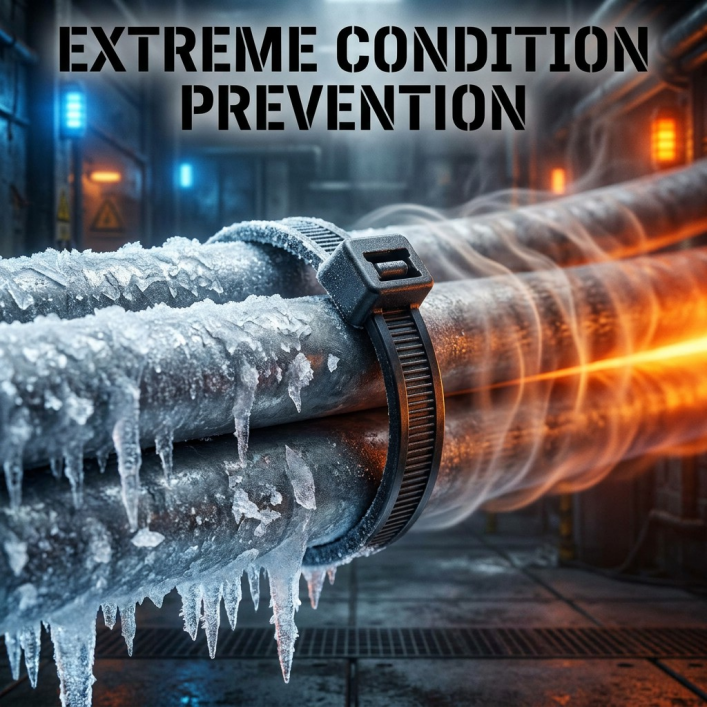
Plastic is a polymer—a chain of molecules. Heat adds energy to these chains, causing them to vibrate. If the heat is high enough, it breaks the molecular bonds. For standard plastics, this results in:
To combat these effects, engineers have developed specialized polymers that maintain their structural integrity at extreme temperatures.
1. Heat-Stabilized Nylon 66 (HS)By adding specialized stabilizers to the Nylon 66 resin, manufacturers can extend the continuous operating temperature to 105°C or 125°C. These ties are the standard choice for automotive engine compartments and industrial lighting systems
where temperatures are elevated but not extreme.
Recognizable by their distinct blue color, Tefzel cable ties are designed for environments reaching up to 150°C (302°F). They are highly resistant to radiation and chemicals, making them the default choice for nuclear power plants, aerospace wiring, and chemical processing facilities.
When performance is non-negotiable at the highest temperatures, PEEK is the answer. These ties can withstand continuous exposure to 260°C (500°F). PEEK is lightweight like plastic but offers a strength-to-weight ratio comparable to some metals.
For environments where temperatures exceed 500°C or involve open flames, metal is the only option. Stainless steel ties provide fire-proof security for oil rigs, refineries, and heavy-duty infrastructure.
Modern engines are becoming smaller and hotter due to turbocharging and tighter engine bays. Using heat-stabilized ties for sensors and fuel lines prevents "heat-soak" failures that can disable a vehicle.
Solar panels are often located in deserts where ambient temperatures combined with direct sunlight can push surface temperatures to 90°C+. UV-resistant AND heat-stabilized ties are essential to prevent the collapse of cable arrays over the 20-year lifespan of the farm.
In aviation, weight and reliability are everything. High-temperature plastic ties like PEEK allow for secure fastening in high-heat zones without the weight penalty of metal clamps.
In critical systems, the cost of a cable tie is negligible compared to the cost of the system it protects. However, the choice of that cable tie is a multi-million dollar decision. By matching the fastening material to the thermal reality of the environment, engineers can eliminate one of the most common—and preventable—causes of system failure.
Copyright © 2025 by Yueqing Chengxiang Plastic Co., Ltd.
 EN
EN


